

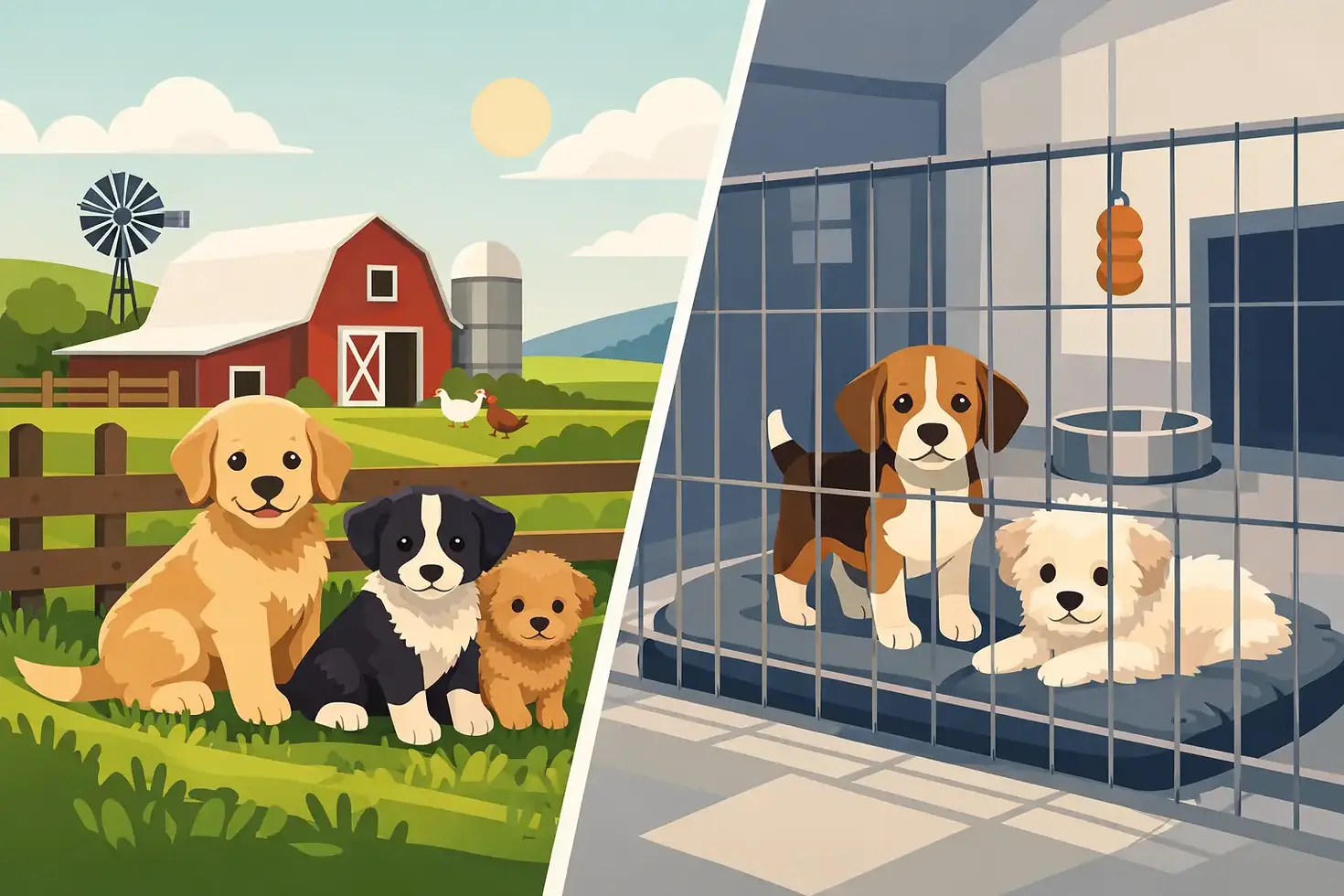
Farm Raised vs Kennel Raised Puppies

When families start comparing farm raised vs kennel raised puppies, they are usually asking a deeper question: what kind of start will help this puppy grow into a calm, loving, family-ready companion? That question matters even more with Bernedoodles, because early environment can shape how confidently a puppy handles children, routines, visitors, grooming, training, and everyday home life.
Not every farm setup is excellent, and not every kennel setup is poor. The real difference comes down to how puppies are raised day by day. Still, the environment does influence what puppies experience in those first formative weeks, and those weeks matter.
Farm Raised vs Kennel Raised: What people really mean
A farm raised puppy is usually being brought up in a home-connected, family-centered setting with regular human interaction, changing sights and sounds, and more natural exposure to daily life. On a well-run family farm, puppies may hear vacuum cleaners, children playing, doors opening, other animals moving around, and all the little rhythms that make up a real household.
A kennel raised puppy is usually raised in a more separate breeding facility, often with a structure built around efficiency, sanitation, and housing multiple dogs. That does not automatically mean the puppies are neglected or poorly cared for. Some kennel programs are clean, responsible, and attentive. But kennel life can be more limited if puppies do not get enough one-on-one handling, varied stimulation, and early practice with the kinds of experiences they will meet in a family home.
For most Bernedoodle buyers, this is not just a question of location. It is a question of lifestyle preparation.
Why early environment matters so much for Bernedoodles
Bernedoodles are loved for their affectionate nature, intelligence, and family-friendly personality. They can also be sensitive, observant, and highly responsive to their environment. That is one reason they often do beautifully as companion dogs and, in some cases, even in service-oriented roles. It is also why the quality of early socialization matters so much.
A puppy that spends its first weeks around everyday family activity often has more opportunities to build confidence in normal home situations. That can mean a smoother transition when the puppy goes home and starts learning crate training, leash walking, grooming routines, car rides, and polite behavior with guests.
A puppy raised in a quieter or more isolated setting may still become a wonderful dog, but it may need more patient work adjusting to household life. Some puppies are naturally resilient. Others need more gradual support. Good breeders understand that difference and prepare accordingly.
The strengths of a farm-raised puppy
In a healthy family-farm environment, puppies often get repeated, gentle exposure to human touch, noise, movement, and changing routines. That can be a real advantage for families who want a puppy that feels connected to people from the start.
For Bernedoodles, that early closeness often supports the traits families are looking for most: affection, emotional steadiness, and responsiveness. Puppies raised this way may already be learning that people are safe, handling is normal, and the world is full of manageable experiences instead of frightening ones.
This kind of setting can also encourage more natural social development. Puppies may interact with adults, children, littermates, and trusted household activity in a way that feels woven into daily life instead of separate from it. When done thoughtfully, that often creates a puppy that is curious without being overwhelmed.
For families with kids, guests, or busy schedules, that early adaptability can make a meaningful difference. It does not replace training, but it can give training a stronger foundation.
Where kennel-raised puppies can fall short
The biggest concern with kennel-raised puppies is not the building itself. It is the risk of limited personal attention and limited life exposure.
If puppies spend most of their time in a more controlled kennel environment, they may have fewer chances to practice the little things that become important later. Being picked up often, hearing family noise, settling after activity, meeting different people, and moving through changing environments all help shape resilience.
When those experiences are missing, new owners may notice that the puppy is slower to adapt to normal home life. That can show up as extra sensitivity to sounds, uncertainty with guests, difficulty settling indoors, or more stress during transitions like grooming and crate training.
That said, some kennel programs work hard to add socialization, enrichment, and regular handling. So the better question is not just farm or kennel. It is how intentional the breeder is.
What to ask instead of just farm or kennel
If you are choosing between breeders, the label alone will not tell you enough. A beautiful website or a simple phrase like family raised is not the full story either. You want to understand what the puppy is actually experiencing before coming home.
Ask how often the puppies are handled. Ask whether they are exposed to household sounds, children, grooming routines, and different surfaces. Ask how the breeder evaluates temperament and how they help match puppies to homes. Ask what support is offered once your puppy leaves.
For Bernedoodle families, this matters because temperament is not only inherited. It is also shaped by early care. A puppy with wonderful genetic potential still needs thoughtful socialization to thrive.
A trustworthy breeder should be comfortable answering these questions clearly and warmly. You should feel like they care where the puppy is going, not just that the puppy is leaving.
Farm raised vs kennel raised for family life
For most households, especially first-time Bernedoodle owners, a farm-raised puppy from a hands-on family breeder often feels like a more natural fit. The transition from breeder to home can be gentler when the puppy has already experienced a setting that resembles family life.
That matters if you are raising young children, managing a work-from-home routine, or hoping for a dog that can settle into both active and quiet moments. Bernedoodles tend to bond closely with their people, and a puppy that starts life with frequent human connection often carries that comfort forward.
This does not mean a farm-raised puppy will arrive fully trained or without challenges. Every puppy still needs structure, consistency, patience, and continued socialization. There will still be potty accidents, teething, nighttime adjustments, and training work. A loving start helps, but it does not remove the responsibility of puppy ownership.
That is an important point for families to remember. The right breeder gives your puppy a strong beginning. You still shape what comes next.
Why this choice matters for mini and standard Bernedoodles
Both mini and standard Bernedoodles benefit from early socialization, but the way that plays out at home may look a little different. Mini Bernedoodles are often chosen by families who want a smaller companion with an easy-to-integrate size, while standard Bernedoodles may be selected for their bigger presence, affectionate nature, and versatility.
In both cases, buyers are usually looking for a dog that is gentle, trainable, and deeply connected to family life. That is why a home-oriented farm setting can be such a meaningful advantage. It helps prepare puppies for the exact thing most Bernedoodle families want - a true companion dog, not just a pet that has to slowly learn what family life is.
At Doodles4Love, that family-first beginning is part of what we believe matters most. Puppies should not simply be cared for. They should be known, handled, guided, and prepared for the homes they are heading into.
The best choice is the one with thoughtful early care
If you are weighing farm raised vs kennel raised, try not to stop at the phrase itself. Look at the daily experience behind it. A puppy's first weeks should include warmth, human connection, gentle exposure, and intentional preparation for life in a home.
For Bernedoodle families, especially those welcoming a puppy into the center of everyday life, that beginning can shape more than convenience. It can shape trust, confidence, and the kind of bond that grows more beautiful with time.
A good breeder does more than produce puppies. They help start the relationship between your family and your future best friend in the right way, and that is worth choosing carefully.


Comments